
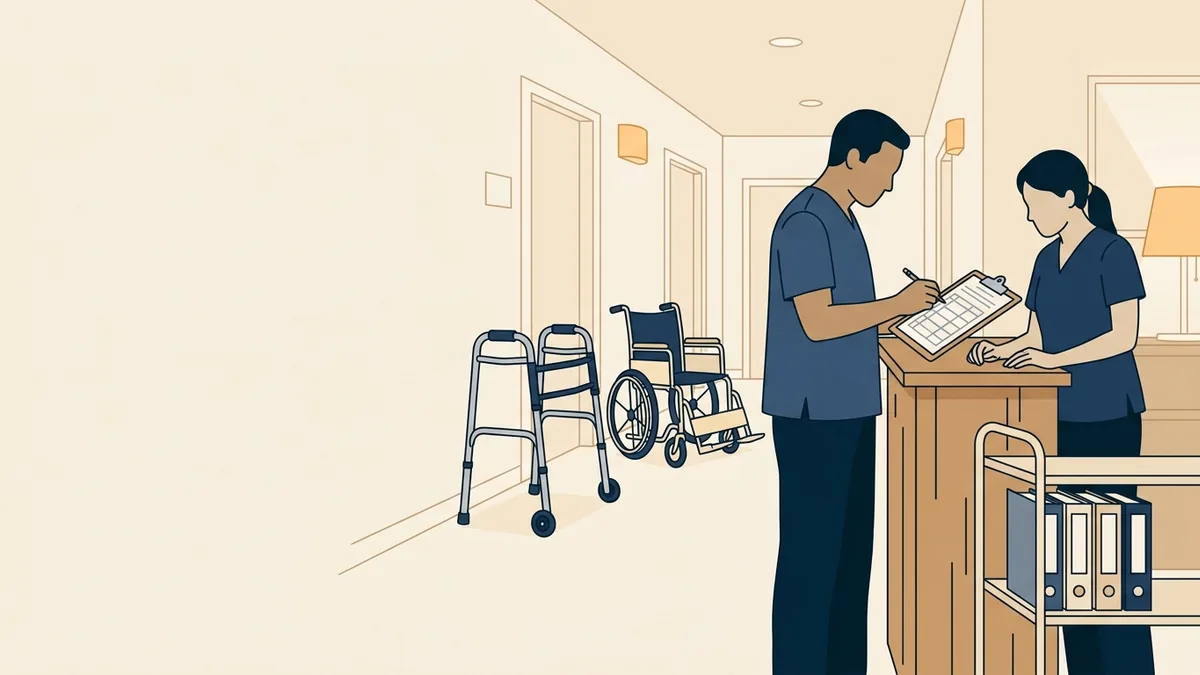
Every state rule we have checked requires OTAs to work under OT supervision, but the specifics vary. Oregon requires the supervising OT on file with the board before work starts, Kentucky four hours a month including two face-to-face, Pennsylvania contact for 10 percent of patient care time, and New Jersey limits each OT to five supervised licensees.
Every state rule we have checked requires an occupational therapy assistant to work under the supervision of an occupational therapist. What differs is everything else: how often the OT must be in the room, whether supervision can happen by video, how many people one OT may supervise, what has to be logged and countersigned, and whether the supervisor has to be on file with the board before the OTA starts. An OTA moving states, or an OT supervising across a state line, needs the new state's rule, not the old one.
Why do these rules matter more when you move?
Because OTAs and OTs carry habits from one state to another, and the new state's board judges you by its own rule. Under the OT Compact, Section 4C of the model law says anyone practicing on a privilege "shall function within the laws and regulations of the Remote State," and Section 4D adds that an OTA in a remote state "shall be supervised by an Occupational Therapist licensed or holding a Compact Privilege in that Remote State." The same logic applies to a regular license: the state where the client is sets the supervision standard.
A supervision problem can also reach both licenses: the OTA who practiced outside the rule, and the OT who supervised outside it.
Which states set the rules that surprise people?
These are the rules we have verified in each state's regulations or board guidance, as of October 2026. They are summaries; read the full rule before you start work.
Oregon: supervisor on file before the first day
The Oregon Occupational Therapy Licensing Board says "before an OTA can start working they must file their OT Supervisor with the board." Under OAR 339-010-0035, the OTA records the supervising OT, the site and the start date in the board's online license portal, and the OT then logs in and changes the status to "approved." An OTA "always requires at least general supervision," which Oregon defines as at least monthly direct contact in person at the work site or via telehealth (OAR 339-010-0005). Changing jobs means updating the portal before the first shift at the new site. Oregon is not in the OT Compact.
Kentucky: hours per month, countersignatures and logs
201 KAR 28:130 requires the supervising OT to provide "no less than four (4) hours per month of general supervision for each occupational therapy assistant," including at least two hours a month face-to-face, prorated for part-time OTAs. Face-to-face means "being physically present in the room." OTA notes on an initial evaluation, plan of care or discharge summary must be countersigned within 14 calendar days, and both the OT and the OTA keep a supervision log. Kentucky has enacted the OT Compact but was not issuing privileges as of October 2026.
Pennsylvania: a share of patient care time
Under 49 Pa. Code § 42.22, the supervising OT must have supervisory contact with the OTA "at least 10% of the time worked by the assistant in direct patient care." Face-to-face contact must happen on site at least once a month and include observing the OTA treat. The OT keeps a supervisory plan, documents the supervision, and writes an appraisal of the OTA's performance at least annually. Pennsylvania has enacted the compact and is not yet issuing.
New Jersey: experience to supervise, and a cap
New Jersey limits who can supervise and how many. Under N.J.A.C. 13:44K-6.2, an OT needs at least 1,200 hours of work experience, gained over no less than one year and within three consecutive years, before supervising anyone. An OT may supervise no more than five licensees (OTAs and temporary licensees), and no more than seven people in total including fieldwork students, and must keep a written supervision plan. A newly licensed OT cannot be the designated supervisor for an OTA there. New Jersey is not in the compact.
Texas: temporary licensees supervise no one
Texas temporary licenses are only for first-time NBCOT examinees, and under 40 Tex. Admin. Code § 373.2 "temporary licensees may not supervise anyone." An OTA on a Texas temporary license needs an OT or OTA with a regular license on the premises whenever providing services, at least 16 supervision hours a month for each employer recorded in a supervision log, and co-signature on documentation that goes into the client's permanent file. Texas is not in the compact.
New Mexico: supervision logs on file
The New Mexico Board of Examiners for Occupational Therapy publishes a supervision log form whose instructions say a copy "must be submitted to the Board prior to issuance of full licensure, prior to renewal of any COTA license, and at any time upon request." The form is older, so check the board's current rule (Title 16, Chapter 15, Part 3 NMAC) before relying on it. New Mexico is not in the compact.
Wisconsin schools: a stricter standard inside schools
In Wisconsin public schools, Wis. Admin. Code PI 11.24 requires either daily on-premises contact or face-to-face contact at least every 14 calendar days plus a monthly on-site reevaluation of each child. A full-time school OT may supervise no more than two full-time-equivalent OTA positions, and no more than three OTAs. See Wisconsin's school OT license.
Which duties stay with the supervising OT?
Beyond contact hours, the rules also divide the work, and those lines move between states too.
- Pennsylvania defines supervision as the OT evaluating the client, preparing a written program plan, assigning treatment duties to an OTA trained to carry them out, monitoring the OTA's performance and accepting professional responsibility for it (49 Pa. Code § 42.22(a)). The OT may assign a competent OTA standardized tests, activities of daily living evaluations and other parts of evaluation that do not require the OT's professional judgment (§ 42.22(c)).
- Kentucky says the OTA "may not evaluate independently or initiate therapy prior to" the OT's evaluation, and gives the OT primary responsibility for intervention planning and for discontinuing services, with the OTA contributing as directed (201 KAR 28:130).
- New Jersey keeps responsibility for the client's OT care with the supervising OT, and when the supervisor changes, the next OT "shall assume responsibility for the ongoing supervision" and becomes the designated supervisor (N.J.A.C. 13:44K-6.1).
So an OTA who routinely ran reassessments in one state may need the OT to take them back in the next, and a handoff between supervising OTs is a formal event in some states, not just a schedule change.
Can supervision happen by telehealth?
Sometimes. Oregon's definitions expressly allow routine and general supervision contact "via telehealth." Pennsylvania requires on-site face-to-face contact monthly, and Kentucky's face-to-face hours require physical presence. Do not assume that a remote supervision arrangement that worked in one state works in the next. See telehealth across state lines.
Does Medicare have its own supervision rule?
Yes, as a floor. In an OT private practice, an OTA may perform services under the OT's general supervision (42 CFR 410.59(c)(2)), and Medicare pays only for services by "an appropriately supervised occupational therapy assistant." State rules still apply on top. Where Kentucky requires two face-to-face hours a month, Medicare's general supervision does not lower that. See Medicare enrollment for OTs.
Which checks should an OTA run before the first shift in a new state?
- Is my license or privilege active in this state? Not pending, not "approved but not issued." Texas, for one, says a license is usable once it shows as current with its expiration date on the board's verification page.
- Is my supervising OT authorized in this state? Licensed there or holding a compact privilege there, with enough experience if the state requires it.
- Does the board need to know who supervises me before I start? Oregon does.
- What minimum contact applies, and how is it counted? Hours per month, a percentage of patient time, or a frequency.
- Which documents need the OT's countersignature, and by when?
- Who keeps the supervision log, and does the board collect it?
- Does this setting add rules? Schools in Wisconsin do; Medicare private practices do.
How do we help OTAs and supervising OTs?
Our OTA license by endorsement ($499 per state) includes the supervision paperwork some states require before you start work, such as Oregon's portal filing. For OTAs who live in a compact state, the Compact Privilege Concierge covers eligibility, the background check and jurisprudence before the guided session in which you complete and submit your own application. See also licensing as an OTA in another state and the OT Compact for OTAs. For the physical therapy side, our sister site covers PTA supervision in a new state.
Common questions
- Can an OTA work without a supervisor on file in Oregon?
- No. Oregon's board says an OTA must file the supervising OT in the license portal, and the OT must approve it, before the OTA starts working.
- How many hours of supervision does Kentucky require for an OTA?
- At least four hours a month of general supervision per OTA, including at least two hours face-to-face, prorated for part-time OTAs, under 201 KAR 28:130.
- Can a new graduate OT supervise an OTA in New Jersey?
- No. New Jersey requires 1,200 hours of OT work experience, gained over at least one year within three consecutive years, before an OT may supervise.
- Who supervises an OTA working on an OT Compact privilege?
- An OT licensed or holding a compact privilege in the state where the OTA is working, under that state's supervision rules.
- Can OTAs be supervised by video?
- It depends on the state. Oregon allows some supervision contact via telehealth; Pennsylvania and Kentucky require on-site or in-person face-to-face contact.
Need Help with Your Application?
We handle the OT licensing process end-to-end — eligibility screening, documents, board follow-ups, and tracking.