
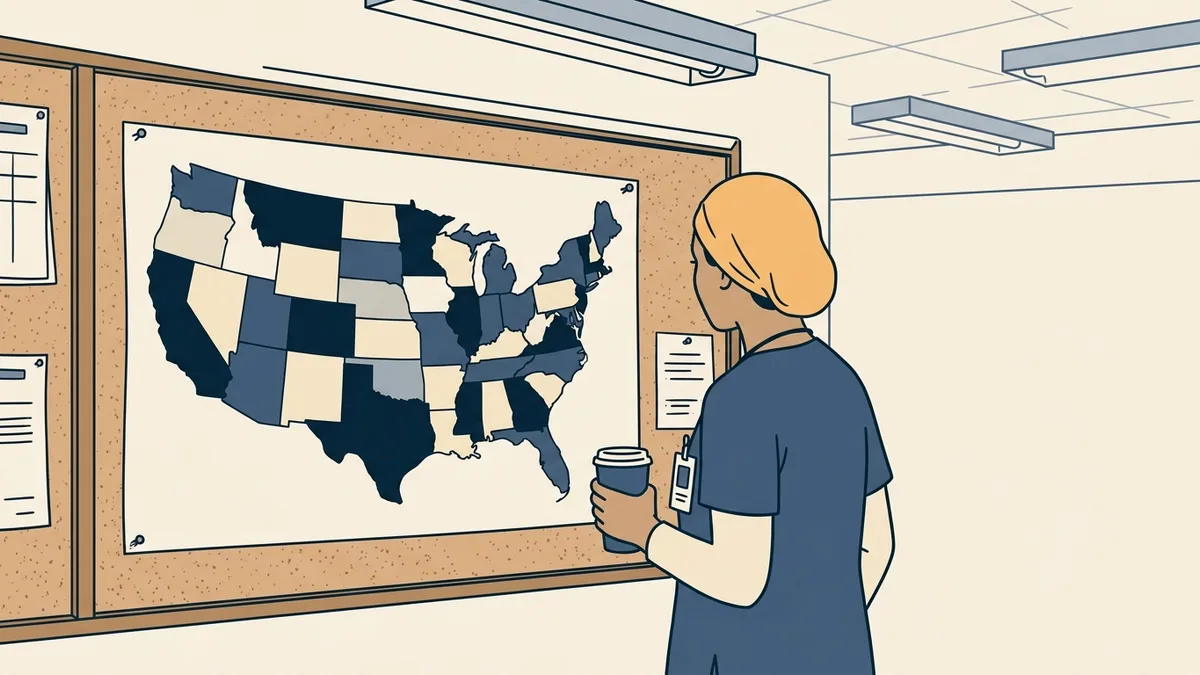
An enacted state has passed the OT Compact law; an issuing state is accepting privilege applications. Only issuing states let you use the compact. As of October 5, 2026, 37 states had enacted it and 10 were issuing. Each board sets its own launch date after meeting the Commission's requirements, including FBI background checks.
A state that has "enacted" the OT Compact has passed the law. A state that is "issuing" has finished setting it up and is accepting privilege applications. Only issuing states count. As of October 5, 2026, 37 states had enacted the compact and 10 were issuing, according to the OT Compact Commission's map and its Before You Apply page. The other 27 do not yet give you any way to practice there without a license.
Why doesn't enactment let me practice there?
Because the law only makes the state a member. The board then has to build the machinery. The Commission's FAQ answers the question directly: when the compact is enacted in your state, it "does not automatically approve your license for use in other states." Its homepage is even plainer: "You cannot practice in an OTC state under the OT Compact, even if that state has enacted OTC legislation. You can only apply when the state opens applications, deems you eligible to apply, AND your application is approved."
Until then, the homepage says, "you need a license to practice in any state you wish to provide OT services."
What does a state have to finish before it issues?
OTC Rule 5.1 lists four things a new member must complete before it "can participate in issuing or recognizing compact Privileges to Practice":
- Fully implement the FBI criminal background check requirement.
- Require continuing competence or education for OT and OTA renewal.
- Use only a recognized national exam for licensure, which Rule 7.1 defines as the NBCOT exam, its predecessor or successor.
- Fully implement the Commission's data system reporting requirements.
The first one is usually the slowest. A board needs an FBI-assigned identifier, called an ORI, to receive FBI results (OTC Rule 4.2), and OTC Rule 4.4 exists because some boards applied and were refused. The Commission adopted a rule for states that were refused, and Virginia is issuing under it with a temporary state-police check. See the FBI background check.
Who decides when a state goes live?
The state board. The Commission's FAQ says each member state "will launch OTC applications on their own timeline," and "the OTC administrators do not set the timeline." If you want to know when your state will open, the Commission's advice is to ask that state's OT licensing board.
The gap between law and launch can be long. Colorado's compact bill on the Commission's map is HB21-1279, from 2021, and Kentucky's is HB 213 from the 2022 session; neither was issuing in October 2026. Arkansas's law is Act 257 of 2023, and Arkansas began issuing on October 5, 2026.
How do I tell where a state really stands?
Use the Commission's Before You Apply page, not the map. The map's dataset sorts states into "Compact Member - Issuing Privileges," "Enacted," "Filed" and "Not Enacted," and the map page itself was last updated in August 2026. The Before You Apply page lists, state by state, whether it is "Accepting OTC Applications," with the date it started, its fees and its jurisprudence rule, and it was updated October 5, 2026.
Watch for three signals on that page:
- A date in the "Accepting" column. That state is issuing.
- "Not Yet" with a fee listed. The state has set its fee but is not open. Alaska, Washington and Montana were in this group in October 2026. A fee is not a launch date.
- Missing entirely. Pennsylvania is on the map as enacted but did not appear in the Before You Apply table as of October 8, 2026. Treat it as not issuing.
Secondary sources, such as agency guides and blog posts, can lag behind it. Check the Commission's page on the day you plan to apply. Our current list is in which states are issuing OT Compact privileges.
Where does that leave me if my state is enacted but not issuing?
If you live there, you have no working home state for now, so every other state you work in needs a license. If you want to work there, you need its license. Either way, a license by endorsement is the bridge, and you can keep it after the state goes live. See compact privilege or a state license? and our state license index.
Our OT Compact Readiness Review ($149) checks the live status of your home state and every target state on the day we review your file, and tells you which ones need a license now. When a state you care about opens, the Compact Privilege Concierge prepares your background check and jurisprudence and guides you while you complete and submit your own application. More at the OT Compact hub.
Common questions
- My state enacted the OT Compact. Can I practice in other compact states now?
- No. The Commission says enactment does not approve your license for use elsewhere. You can apply only once your home state and the target state are both accepting applications.
- Who decides when a state starts issuing OT Compact privileges?
- The state's own OT licensing board. The Commission says its administrators do not set the timeline.
- Is the OT Compact map or the Before You Apply page more current?
- The Before You Apply page. It lists each state's application status, start date, fees and jurisprudence rule, and was updated October 5, 2026.
Need Help with Your Application?
We handle the OT licensing process end-to-end — eligibility screening, documents, board follow-ups, and tracking.