
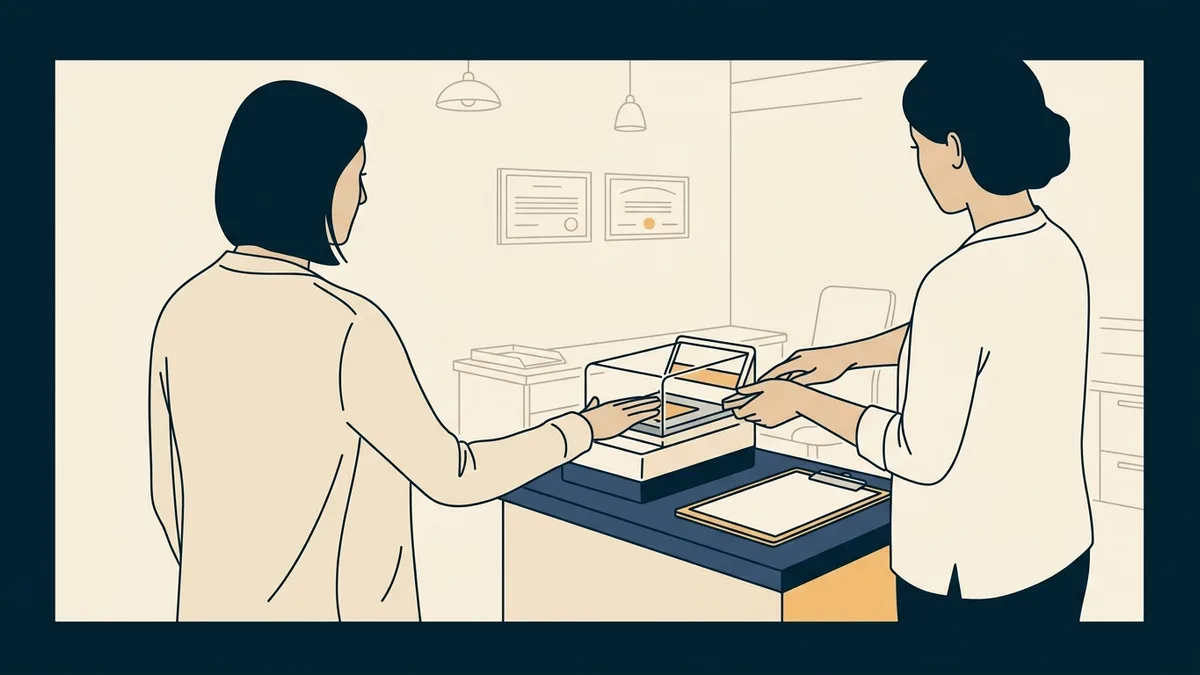
To get any OT Compact privilege you need a fingerprint-based FBI and state criminal background check through your home state's OT board. The Commission does not run it, only your home board sees the results, and you pay for it. Some states without FBI access, like Virginia, use a state check plus a signed attestation for now.
Every OT Compact privilege starts with a criminal background check through your home state's OT licensing board, including an FBI check based on your fingerprints. Your home board will not treat you as eligible for the compact until the FBI results are back. The OT Compact Commission does not run or arrange these checks; its Before You Apply page says "the OT Compact staff does not conduct or facilitate CBCs," and tells applicants to contact their home board for instructions.
Why does the compact require an FBI check?
It is written into the compact itself. Section 3A5 of the model law requires each member state to use fingerprints "for the purpose of obtaining an applicant's criminal history record information from the Federal Bureau of Investigation and the agency responsible for retaining that State's criminal records." Section 4A8 makes completing it a condition of the privilege, and Section 4A8a says the licensee pays for it.
The Commission's rules fill in the details. OTC Rule 4.5 says an applicant "shall provide a full set of fingerprints to the Home state's designated agency" for checks through the FBI and the home state's records agency, and Rule 4.5F applies the requirement to "all compact privilege applicants."
Who sees the results?
Only your home board. OTC Rule 4.1 says the results "shall be reviewed solely by the Home state in accordance with state law and shall not be shared, unless otherwise permitted under state law, with individuals, other member states, or the Commission." Section 3A5b of the model law also bars sharing FBI information between states through the compact. The remote states learn only whether your home state considers you eligible.
That means your home board decides whether something in your history disqualifies you from the compact. Rule 4.5D says an applicant whose check "reveals disqualifying offenses, as determined by the Home state," is ineligible "to obtain, retain, or renew a compact privilege."
Do I need one if I was fingerprinted for my license?
Maybe not a new one, but you need one on file with your home board that meets the compact's terms. The Commission's FAQ says "some states already perform FBI CBCs" and others are implementing the requirement, and that a licensee who has "never had a criminal background check" must complete one through the home board. Licensed under older rules or grandfathered in? You can still participate, but you need the check.
Ask your home board one specific question: is the background check from my license application accepted for the compact, or do I need a new one? Some boards built a separate compact process. The West Virginia Board of Occupational Therapy, for example, publishes separate instructions for West Virginia residents seeking privileges and says they "will not be able to create an account in CompactConnect" until the FBI check is completed and the board has the results.
What is Virginia's workaround?
Not every state could get FBI access in time. The Commission adopted OTC Rule 4.4 for states that tried and were refused an FBI identifier, and a policy effective September 10, 2026 sets out how the Commission's Executive Committee decides those requests case by case.
Virginia is a live example. The Virginia Board of Medicine says Virginia licensees seeking privileges must get "a fingerprint-based criminal history record check from Virginia State Police" for the board's review, and submit an attestation that they have no current FBI criminal background history and agree to complete an FBI check "within sixty (60) days of notification of Virginia's ability to perform FBI CBCs." That matches OTC Rule 4.5C, which allows a state-based check plus that attestation where an FBI check is legally impossible, and says failing to complete the FBI check on time "may result in the removal of compact privileges."
If your home state is using this route, put the 60-day deadline on your calendar the day you hear from the board.
What usually slows it down?
- Using the wrong instructions. A compact check may use a different form, code or vendor than your original license application. Get the compact instructions from your home board's page.
- Fingerprinting away from home. If you are on assignment in another state, ask your home board whether and how it accepts prints taken there before you book an appointment.
- A record that needs review. Your home board may ask for court documents or an explanation before deciding eligibility.
- A board address that does not match your residence. Virginia, for one, requires your Virginia home address on file. See your home state and the OT Compact.
Does moving mean another check?
It can. When you move between two member states, the new home state can require "an FBI fingerprint based criminal background check if not previously performed or updated," plus any other check it requires (Section 5B2 of the model law). Moving outside the compact means a new license application, which often has its own fingerprint requirement. Texas, for instance, has required fingerprinting for OT and OTA license issuance since January 1, 2019, according to its board.
Is this the same check a license by endorsement needs?
Sometimes similar, often not the same. Each board sets its own license requirements. The Maryland Board of Occupational Therapy Practice, for example, asks license applicants for a state and FBI criminal history records check and says fingerprint results are only valid for 30 days after fingerprinting, so the application has to go in within that window. Our fingerprints and background checks for OT licenses post covers license applications state by state.
How do we help with it?
The check runs through your home board and is paid by you, as the compact requires. Our Fingerprint Coordination service ($75 to $150 per state) finds the right compact instructions, schedules your prints, handles ink-card routing if you are out of state, and tracks the result with the board. It is part of every Compact Privilege Concierge engagement, so the check is cleared before the guided session in which you complete and submit your own privilege application. If you are not sure the compact works for you yet, start with the OT Compact Readiness Review ($149), or read the OT Compact, explained.
Common questions
- Does the OT Compact Commission run my background check?
- No. The Commission says its staff does not conduct or facilitate background checks. Your home state's OT licensing board runs it and decides eligibility.
- Will other compact states see my criminal history?
- No. Commission rules say the results are reviewed solely by your home state and not shared with other states or the Commission, unless state law permits.
- Do I need a new FBI check if I was fingerprinted for my license?
- Ask your home board. Some accept an existing FBI check; others have a separate compact process. If you never had one, you must complete it.
- Why does Virginia use a state police check for OT Compact privileges?
- Virginia could not yet perform FBI checks, so it uses a Virginia State Police fingerprint check plus your attestation, and you must complete an FBI check within 60 days of being notified it is available.
Need Help with Your Application?
We handle the OT licensing process end-to-end — eligibility screening, documents, board follow-ups, and tracking.