
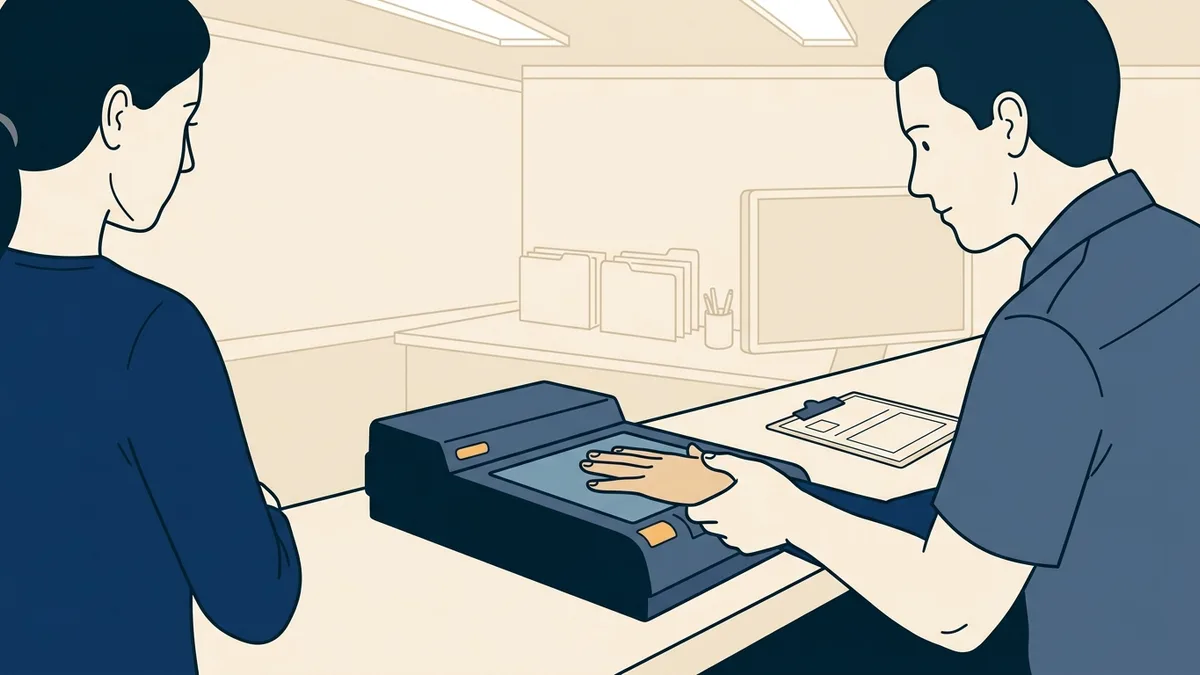
Most OT boards require fingerprints for a state and FBI background check before issuing a license, and the OT Compact requires an FBI check through your home board before any privilege. Out-of-state applicants often use board-specific paper cards, results may need to come directly from a state bureau, and prints for one agency usually cannot be reused for another.
Expect to be fingerprinted for almost every new OT or OTA license, and for any OT Compact privilege. Boards use your fingerprints to pull your criminal history from the state's records bureau and from the FBI. The process itself is quick. What delays applications is the channel: each board names exactly how prints must be taken and how results must reach it, and results sent the wrong way are not accepted.
Which checks do boards run?
Usually two at once, state and federal, from one set of prints.
- California "requires a Department of Justice (DOJ) and Federal Bureau of Investigation (FBI) criminal history background check on all applicants," and its board says a license "will not be issued until the Board receives the background information from DOJ."
- Texas requires every initial applicant to submit "a complete and legible set of fingerprints" for criminal history from "the Department of Public Safety and the Federal Bureau of Investigation" (40 Tex. Admin. Code § 364.1(a)(5)).
- Ohio requires a check by its Bureau of Criminal Identification and Investigation, and the applicant must ask the bureau to obtain FBI information too (Ohio Admin. Code 4755-3-05(C)).
The exact vendor, form and fee are set state by state. Your state's page in our license index notes whether fingerprints are required.
How do out-of-state applicants get printed?
This is where most problems start. Many states run electronic fingerprinting only inside their borders, so applicants who live elsewhere use paper cards. California's rule for nonresidents: "you must submit fingerprint cards along with your application," and "you must use the Board's pre-printed fingerprint cards." The board charges a $49 processing fee, will not process the cards until the fee arrives, and says clearance "can take 6-8 weeks once the fingerprint cards are received."
Paper cards fail for ordinary reasons: smudged or rolled-off prints, the wrong card stock, missing fields. A rejected card sends you back to the start of that 6-to-8-week window. Have them rolled by someone who does it every day, check every box, and send them with the application as the board instructs.
Can you reuse fingerprints from another application?
Usually not across agencies. California is blunt: "You will have to submit fingerprints specifically for the Board regardless of whether you have recently been fingerprinted for other employment or licensing purposes. Criminal background information cannot be shared among organizations." Federal rules on FBI record sharing are a large part of why: the OT Compact itself says that communication among member states about eligibility "shall not include any information received from the Federal Bureau of Investigation relating to a federal criminal records check performed by a Member State under Public Law 92-544" (OT Compact, Section 3.A.5.b).
Within one board, reuse is more common. Texas does not require new prints at renewal or restoration if you already submitted them for your initial license or a prior renewal (40 Tex. Admin. Code §§ 370.1, 370.3). Ohio accepts a check already on file only if the board received it within the last six months: "A new criminal records check will be required if the applicant's criminal records check on file with the board is greater than six months old" (Ohio Admin. Code 4755-3-05(E)).
Do results have to come from the agency?
Often, yes. Ohio "will only accept the results of a criminal records check that is submitted to the board directly by the bureau of criminal identification and investigation." A printout you received yourself, however official, does not satisfy that rule. Before you pay for prints, find out whether the board receives results electronically from a specific vendor or wants a sealed result mailed by the bureau.
How does the background check work for the OT Compact?
Before any privilege, your home state must have an FBI fingerprint-based check on file for you. The Commission's FAQ says your home state "will not consider the practitioner eligible to participate in the OTC until an FBI CBC is completed," and its Before You Apply page says to complete the check "through your Home State licensing board," adding that "OT Compact staff does not conduct or facilitate CBCs." The model law makes the licensee responsible for the fee (Section 4.A.8.a).
Two points catch OTs off guard. First, being licensed under older rules does not exempt you: the FAQ says that if you have "never had a criminal background check (CBC), you must complete that through your home state licensing board." Second, the check is done by your home board even though the privilege is for another state. If your home state is not yet issuing privileges, there may be no compact check to do at all. More detail is in the FBI background check for OT Compact privileges.
Does a past conviction stop a license?
Not automatically. Boards weigh convictions under their own laws, and some states limit what they can consider. California's board explains that, under Business and Professions Code section 480 as amended effective July 1, 2020, it cannot deny an application on the basis of a conviction that has been dismissed or expunged, or one more than seven years old (counted from release if incarcerated), with exceptions for serious felonies and offenses requiring sex offender registration. When fingerprint results show a record, the California board "will open an investigation and request supporting documents from the court and arresting agency." Applicants may volunteer an explanation, court records and proof of rehabilitation to speed that review.
Disclosure rules differ by state, and answering a question too narrowly causes more trouble than the record itself. Read disclosing past discipline on an OT application before you answer.
Do renewals trigger new fingerprints?
Sometimes. California requires licensees renewing a license that expires on or after July 1, 2010, who were never fingerprinted by the board or whose prints are no longer on record, to submit fingerprints as a condition of renewal; failing to do so "is grounds for discipline." The requirement is waived for an inactive renewal or a licensee "actively serving in the military outside the country" (16 CCR § 4120(a)(4)). Texas likewise lists fingerprints among renewal components unless you submitted them before (40 Tex. Admin. Code § 370.1).
How do we handle it?
We find out the board's exact channel before anything is rolled, order the right cards or schedule the right vendor, check the card before it ships, and confirm receipt. Fingerprint coordination runs $75 to $150 per state, and it is included in the work around a compact privilege, where we coordinate the home-board FBI check while you complete and pay for the privilege application yourself, as the Commission requires. Government and vendor fees are separate.
Common questions
- Can I use my fingerprints from a previous job for an OT license?
- Usually not. California says you must be fingerprinted specifically for its board, because criminal background information cannot be shared among organizations. Ohio accepts only results sent directly by its state bureau within the last six months.
- How long does California's OT fingerprint clearance take?
- California's board says out-of-state fingerprint card clearance can take 6 to 8 weeks once the cards are received, with a $49 processing fee.
- Does the OT Compact run my background check?
- No. The Commission says its staff does not conduct or facilitate background checks. You complete an FBI check through your home-state licensing board before you can get a privilege.
- I was licensed before background checks were required. Do I need one for the compact?
- Yes. The Commission's FAQ says practitioners who have never had a criminal background check must complete one through their home board.
Need Help with Your Application?
We handle the OT licensing process end-to-end — eligibility screening, documents, board follow-ups, and tracking.