
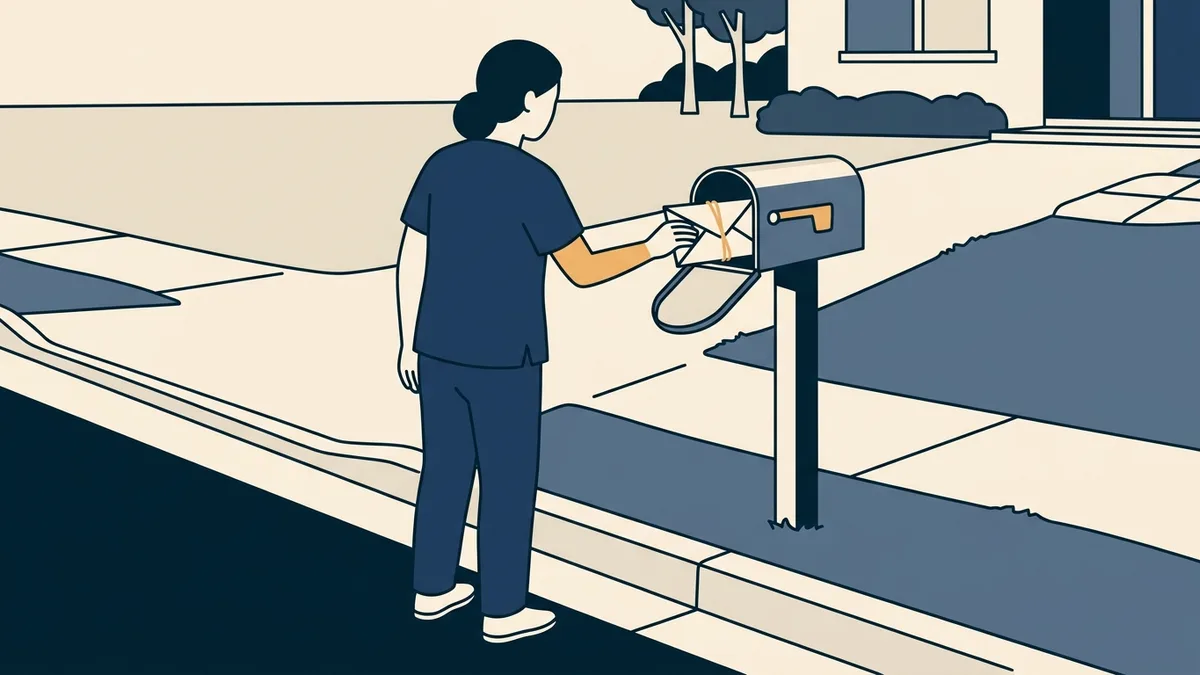
Most stalled OT license applications are missing something the applicant controls: an NBCOT score transfer never ordered, a verification from a forgotten state, fingerprints sent through the wrong channel, an incomplete disclosure, or a jurisprudence exam not yet taken. Boards generally will not review a file until every document arrives.
The OT license applications that stall are usually waiting on something the applicant controls. Boards generally do not chase missing documents for you, and many will not finish reviewing a file until every piece has arrived. The nine mistakes below account for most of the delays we see, and each one traces to a specific rule. Fixing them before you file is the single most reliable way to shorten the wait, though no one can promise a board's timeline.
1. Did you order the NBCOT score transfer?
Every state wants proof that you passed the NBCOT exam, and it wants it from NBCOT, not from you. A copy of your certificate does not count. NBCOT's score transfer page says the transfer is ordered through your MyNBCOT account and "will be sent within three business days of receipt of the request." The fee is $35 per transfer, per NBCOT's fee schedule.
Two traps here. First, only you can order it, because it lives in your MyNBCOT account. Second, a score transfer and a verification of certification are different products. NBCOT's verification letter is free and confirms your current certification status; a board that asks for your exam score wants the score transfer. Texas's endorsement rule, for example, tells applicants to "arrange to have NBCOT send directly to the Board the applicant's NBCOT certification examination score report" (40 Tex. Admin. Code § 364.4). More detail is in sending your NBCOT score to a new board.
2. Did you list every state you have ever been licensed in?
Boards want your full licensing history, including licenses you let lapse years ago, and they want it confirmed by the other board. Texas requires a license verification "if the Board cannot verify the applicant's history of licensure in occupational therapy, including disciplinary action," and says it "must be an original verification sent directly to the Board by the licensing board of the state or territory" (40 Tex. Admin. Code § 364.4(a)(3)). Florida's endorsement statute requires the department to check applicants against the National Practitioner Data Bank (Fla. Stat. § 456.0145(2)(a)).
The forgotten license is the classic stall: a travel contract in another state six years ago, an OTA license you held before finishing your OT degree. If the board finds it and you did not list it, you now have a verification to request and a credibility question to answer. Our post on license verifications between OT boards covers how each board sends them.
3. Were your fingerprints sent through the channel this board accepts?
Fingerprints are the most channel-specific part of any application. California's Board of Occupational Therapy says applicants who live outside California "must submit fingerprint cards along with your application" on "the Board's pre-printed fingerprint cards," with a $49 processing fee, and warns that clearance "can take 6-8 weeks once the fingerprint cards are received." It also says you must be fingerprinted for the board "regardless of whether you have recently been fingerprinted for other employment or licensing purposes."
Ohio will only accept criminal records check results "submitted to the board directly by the bureau of criminal identification and investigation," and a check older than six months must be redone (Ohio Admin. Code 4755-3-05). A card rolled at the wrong vendor, or results mailed to you instead of the board, means starting over. See fingerprints and background checks for OT licenses.
4. Did you answer the disclosure questions the way they were asked?
Applications ask about convictions, discipline, pending investigations and sometimes health conditions, and the wording varies by state. Read each question literally. An applicant who answers "no" because a matter was minor, old or resolved, when the question asked about any matter ever, has created a bigger problem than the original one. Florida's statute allows the board to revoke a license on finding that the licensee "provided false or misleading material information or intentionally omitted material information in an application for licensure" (Fla. Stat. § 456.0145(2)(d)).
California is a useful contrast: its board says applicants with criminal convictions "are not required to disclose a conviction on their application," because fingerprint results reach the board anyway, though volunteering documents can speed review. The rules differ, which is why we read each state's questions before you answer them. Our post on disclosing past discipline goes further.
5. Is there a jurisprudence exam you have not taken?
Several states test you on their own practice act before they license you. Texas lists "a successfully completed Board jurisprudence examination on the Act and Rules" among the requirements for every initial license (40 Tex. Admin. Code § 364.1(a)(3)), and it requires a passing score again at each renewal (§ 370.1). On the compact side, the Commission's Before You Apply page flags jurisprudence requirements for Kentucky, Maryland, Missouri, North Carolina, North Dakota, Ohio and Wisconsin. You take these exams yourself; nobody can sit them for you. See state jurisprudence exams for OTs.
6. Are you applying under the right route?
Most states have separate tracks for new graduates, licensees from other states and former licensees returning, and filing under the wrong one usually means a new application and a new fee. Texas is explicit: "Previous Texas licensees are not eligible for Licensure by Endorsement" (40 Tex. Admin. Code § 364.4). A former Texas licensee applies for restoration instead, under § 370.3, with requirements that depend on how long the license has been expired. Florida's newer endorsement route under the MOBILE Act requires, among other things, at least two years of active practice in the four years before you apply (Fla. Stat. § 456.0145(2)(a)4). If you do not meet a route's conditions, the board will not bend them.
7. Did state-specific coursework slip through?
Some states add training that has nothing to do with your clinical skills. Florida requires a two-hour medical errors course and a two-hour laws and rules course in each renewal cycle, plus one hour of HIV/AIDS education by the first renewal (Fla. Admin. Code R. 64B11-5.001). Texas requires a human trafficking course approved by the Texas Health and Human Services Commission for each renewal (40 Tex. Admin. Code § 367.1). Pennsylvania requires two hours of child abuse recognition and reporting training each biennium (49 Pa. Code § 42.53). These are cheap and quick, and they are exactly what gets forgotten.
8. Did you let a deadline lapse while waiting?
Applications expire. Florida says the application fee "may not be used for more than one year from the original submission of the application," after which a new application and fee are required (Fla. Admin. Code R. 64B11-2.003). Texas requires restoration requirements to "be met within one year of the Board's receipt of the application" (40 Tex. Admin. Code § 370.3(g)). California deems an advanced practice application abandoned if not completed within six months of receipt or a deficiency notice (16 CCR § 4155(c)). A file that sits waiting for one missing document can quietly die.
9. Are you counting on a compact privilege that does not exist yet?
The OT Compact has been enacted in 37 states, but only 10 are issuing privileges as of October 2026: Minnesota, Ohio, West Virginia, Indiana, Virginia, Maryland, Tennessee, Wisconsin, Arkansas and Mississippi. The Commission's FAQ is blunt: enactment "does not automatically approve your license for use in other states." Your home state and the state where you want to work must both be issuing. And the Commission says third parties "may not legally complete the application on behalf of licensees," so an employer or agency that offers to file it for you is offering something the Commission prohibits. See which states are issuing privileges and can someone else apply for my privilege?
How do we keep a file from stalling?
We start with your history, not the form: every license you have held, your NBCOT record, your disclosure answers, and the state's fingerprint channel. Then we build the packet in the order the board reviews it and track each outside document until it lands. A License by Endorsement costs $599 per state for OTs and $499 for OTAs; a Full State License Application for first licenses and states that review the whole file is $749 for OTs and $649 for OTAs. State, NBCOT and fingerprint fees are separate. If you want to know which route fits before paying any of them, start with the state license index or a Readiness Review.
Common questions
- Can I send my own copy of my NBCOT certificate to the board?
- Usually not. Boards want the score sent by NBCOT through a score transfer, which you order in your MyNBCOT account for $35. NBCOT says it goes out within three business days.
- Do I need to list an OT license that expired years ago?
- Yes. Boards ask for every license you have held, and many require a verification sent directly from each board, including discipline history. An unlisted license the board finds on its own causes more delay than listing it.
- Can I reuse fingerprints from another license application?
- Often not. California says you must be fingerprinted specifically for its board, and Ohio accepts only results sent directly by its state bureau that are less than six months old.
- Does an OT license application expire?
- Many do. Florida's application fee is good for one year, Texas restoration requirements must be met within a year, and California abandons an incomplete advanced practice application after six months.
Need Help with Your Application?
We handle the OT licensing process end-to-end — eligibility screening, documents, board follow-ups, and tracking.