
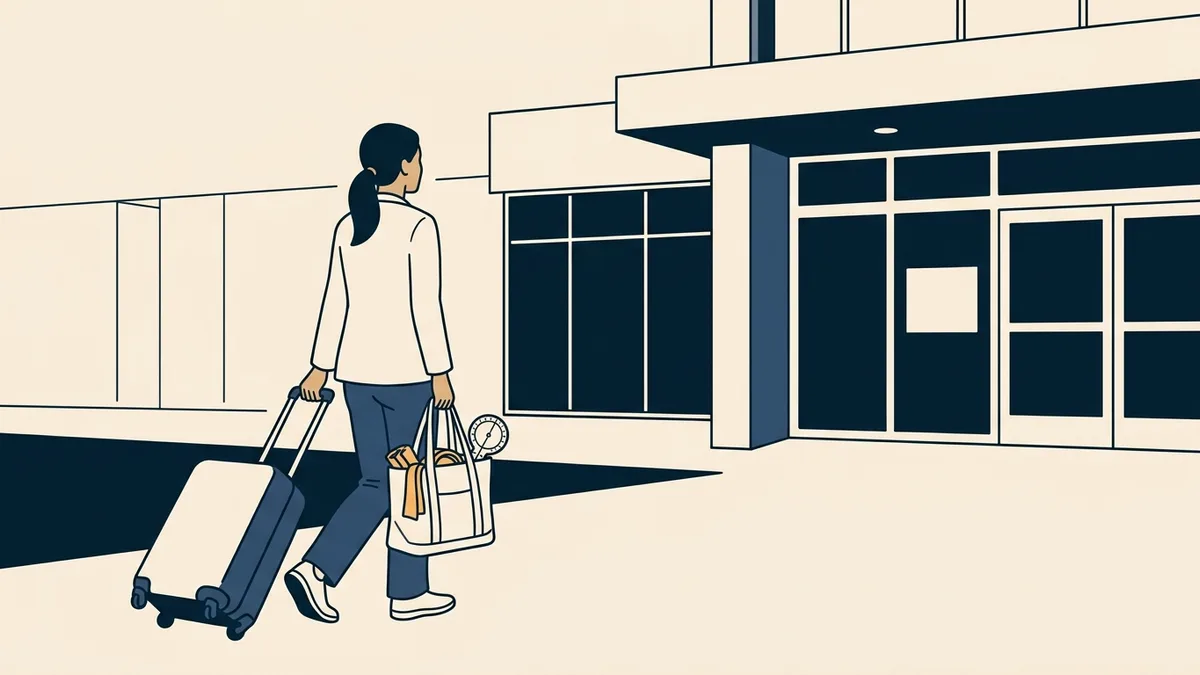
A travel OT needs a license or OT Compact privilege in each state where patients are treated. Privileges work only if your legal residence is in one of the ten issuing states, and only for those states. California, New York, Texas, Florida and every other state need a full license, so start long applications before the contract offer.
A travel occupational therapist needs authorization in every state where a patient is treated: either that state's license or, in a limited set of states, an OT Compact privilege. The compact helps only if your legal residence is in one of the ten states issuing privileges, and only for assignments in those same ten. Everywhere else, including California, New York, Texas and Florida, you need a full state license, and the time it takes to get one is what most often decides which contracts you can accept.
Which states will I need?
The state where the patient is located. The OT Compact model law puts it plainly, "the Practice of Occupational Therapy occurs in the State where the patient/client is located at the time of the patient/client encounter." For a travel contract, that is the state of the facility or, for home health and telehealth, the state where each patient lives or is sitting at the time of the visit.
Your agency's base, your tax home and the state on your NBCOT record do not matter for this.
Can I use the OT Compact as a traveler?
Only if your home state is issuing privileges. The compact's home state is your "primary state of residence," the state where you declare a primary residence for legal purposes "as verified by: driver's license, federal income tax return, lease, deed, mortgage or voter registration" (Section 2U of the model law). That is a legal residence test, and many travelers keep a permanent home in one state while working in others. If that permanent home is in Minnesota, Ohio, West Virginia, Indiana, Virginia, Maryland, Tennessee, Wisconsin, Arkansas or Mississippi, and you hold an unencumbered license there, you can seek privileges in the other nine. See which states are issuing.
If your permanent home is anywhere else, the compact does not help yet, even if you already hold licenses in compact states. A license held by someone not living in a member state "shall not be recognized as granting the Compact Privilege" (Section 3E).
Two rules matter more to travelers than to anyone else:
- Your privileges expire with your home license. If you spend most of the year away, it is easy to let the home license slip. Every privilege goes with it. See renewing privileges.
- You complete the application yourself. The Commission says employing agencies and third parties "may not legally complete the application on behalf of licensees." Your agency can help you prepare but cannot apply for you. See can someone else apply?
Where will I always need a full license?
In every state outside the ten. As of October 2026, that includes the 27 states that have enacted the compact but are not issuing, such as Pennsylvania, North Carolina, Georgia, Colorado and Washington, and the non-members, including California, Texas, Florida, New Jersey and Oregon. New York has only a bill filed. Those four big markets each have their own requirements:
- California OT licensing from another state
- New York OT licensing
- Texas OT licensing
- Florida OT licensing
Every state's requirements are in our state license index.
Which parts of a license application take the longest?
For an OT already licensed elsewhere, most states license by endorsement: they confirm your NBCOT exam result, verify your other licenses and check your background. The steps that stall are usually the ones that depend on someone else.
- The NBCOT score transfer. NBCOT sends your score electronically to a state board "within three business days" of your request in MyNBCOT, for $35 per transfer. Only you can order it. Order it the day you apply.
- License verifications. Boards often want verification from every state where you have been licensed; Maryland's application checklist, for example, asks for letters of verification "from any state or country in which you've been licensed." A traveler with five past states has five boards to chase. See license verifications between OT boards.
- Fingerprints. Texas, for example, has required fingerprinting for license issuance since January 1, 2019, using the board's service code to register. Fingerprinting while you are on assignment in another state can add steps. See fingerprints and background checks.
- Jurisprudence exams. Texas requires every applicant to pass a 20-question open-book online jurisprudence exam on its rules, with no fee and unlimited attempts, according to the Texas board. See state jurisprudence exams.
- State-specific items. Texas began requiring a Social Security number for OT and OTA license issuance and renewal on September 1, 2026. Other states have their own coursework or forms.
For realistic timelines, see how long OT license applications take. We do not quote a board's processing time as a promise, and neither should a recruiter.
Can a temporary license cover the gap?
Rarely for experienced travelers. Temporary and limited permits are mostly designed for new graduates waiting on NBCOT results. Texas, for instance, says its temporary license "is only available to an applicant for licensure by examination who is taking the NBCOT exam for the first time," and Texas temporary licensees "may not supervise anyone." Oregon's limited permit is for students and foreign-educated OTs awaiting NBCOT results, lasts 90 days and cannot be renewed. Plan on the full license. See temporary and limited OT licenses.
When should I start a license for a contract?
Before the offer, if you can. A traveler who holds licenses in the states recruiters fill most often can accept contracts the week they appear. One who starts the application after the offer may lose the contract to someone already licensed. Three practical habits:
- Keep two or three "ready" states. Pick states you would work in again and keep those licenses active between contracts, along with your home license.
- Start the long ones early. If California, New York or another state with a longer process is on your list for next year, start this year.
- Use privileges where they fit. If your legal residence is in an issuing state, the other issuing states can be covered by privileges once your background check is cleared, without a full application in each.
How do I keep several states current?
Every license renews on its own cycle with its own continuing competence rules, and every privilege expires with your home license. Build one calendar with:
- each license's expiration date and CE requirement;
- your home license date, which is also every privilege's expiration date;
- your NBCOT certification renewal, which NBCOT runs on a three-year cycle and which does not renew any state license. See NBCOT renewal and state renewal.
A compact privilege does not require CE in the remote state; the Commission says CE is due only in your home state. Each regular license does require that state's CE. See keeping several OT licenses current.
Is my agency's licensing help enough?
It can be, for the contract in front of you. Agency licensing support is tied to that agency's assignments and its own timeline, and it cannot complete a compact application for you. If you work with several agencies, or want licenses ready before the next offer, you need a plan that belongs to you. See what a travel agency's licensing help covers, and what it does not.
Where do we come in?
We work for you, not for an agency, so the plan follows you from contract to contract. An OT Compact Readiness Review ($149) tells you whether your legal residence makes the compact useful. For each state outside it, our license by endorsement ($599 for OTs, $499 for OTAs) handles the score transfer, verifications and filing end to end; for California, New York, Texas and Florida and other full-file states, the full state license application is $749 ($649 for OTAs). For compact states, the Compact Privilege Concierge prepares your background check and jurisprudence and guides you while you complete and submit each application yourself. Our Annual Renewal & CE Compliance service ($299 per license, per year) keeps the calendar. State, NBCOT and Commission fees are always separate.
Common questions
- Can travel OTs use the OT Compact?
- Yes, if their primary legal residence is in one of the ten states issuing privileges and they hold a license there. Privileges then cover the other issuing states.
- Does my tax home decide my OT Compact home state?
- No. The compact uses your primary state of residence for legal purposes, shown by documents like a driver's license, tax return, lease or voter registration.
- Can I get a temporary OT license for a travel contract?
- Usually not. Temporary licenses and limited permits are mostly for new graduates awaiting NBCOT results. Texas limits its temporary license to first-time NBCOT examinees.
- Can my travel agency apply for my OT Compact privileges?
- No. The Commission says employing agencies and third parties may not complete the application. You apply and pay yourself; your agency can help you prepare.
- How fast does NBCOT send my score to a new state?
- NBCOT says a score transfer ordered through MyNBCOT is sent electronically within three business days. Each transfer costs $35.
Need Help with Your Application?
We handle the OT licensing process end-to-end — eligibility screening, documents, board follow-ups, and tracking.